
WHAT WAS THE PROJECT ABOUT?
Communities are more than groups organized around a purpose. Participants explored how relationships, emotions, rituals, leadership, and invisible norms shape how communities grow, fragment, heal, and transform.
Learning Through Art
The training used theatre, movement, music, storytelling, and reflection to experience community dynamics directly. Instead of only discussing concepts, participants explored them through lived, emotional, and creative processes.
Group Dynamics & Belonging
The project focused on belonging, trust, conflict, safety, and shared meaning inside groups. Participants reflected on what makes people stay, contribute, and feel genuinely connected to a community.
Reflection & Awareness
The training encouraged participants to notice group dynamics that often remain invisible: who speaks and who stays silent, how belonging is created, how tension is avoided, how influence spreads, and what happens when communities stop repairing conflict consciously.
Leadership & Responsibility
Participants explored leadership not only as a formal role, but as the ability to collectively shape group culture through everyday behavior, decisions, communication, boundaries, and care.
Rituals, Meaning & Culture
The training explored how rituals, symbols, language, and shared experiences create community culture. Participants worked with intentional practices that strengthen connection, continuity, and collective identity.
CORE QUESTIONS EXPLORED
What makes people stay in communities long-term?
How is belonging created or unintentionally blocked?
What happens when conflict is avoided instead of repaired?
What makes communities resilient beyond individual leaders?
How do rituals and symbols shape group culture?
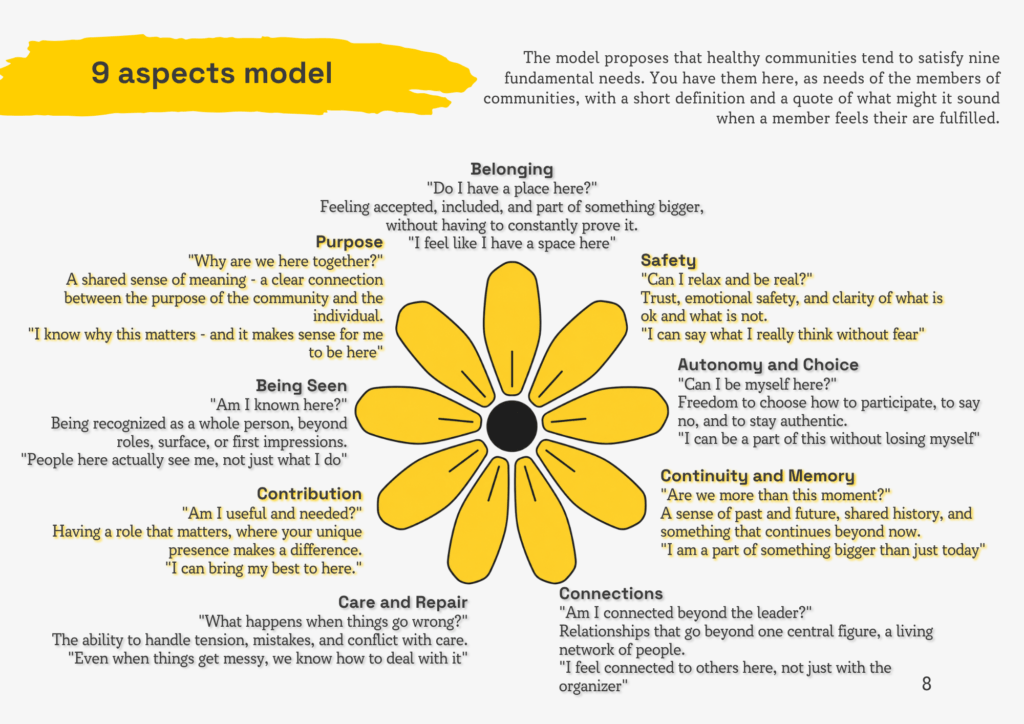
9 ASPECTS OF COMMUNITY MODEL
The training concept and methodological framework were developed by Kris Filipiuk and based on 9 aspects of community. A model that allows looking at groups through different lenses of emotional needs, developed through ongoing work in community-building, facilitation, leadership education, and art-based practice.
WHAT ARE THE OUTCOMES FROM THE PROJECT?
Community Building Guidebook
A practical handbook for community builders, facilitators, educators, and leaders exploring how communities function beyond logistics and coordination.
The guidebook gathers frameworks, diagnostic tools, reflection questions, experiential exercises, and facilitation practices developed and refined during the project. You can preview it below!
Documentary
A documentary exploring community-building processes, participant experiences, and artistic facilitation methods used during the training.
THE TEAM BEHIND ART OF BUILDING COMMUNITIES
Program Lead, Facilitation, logistics, Communication
The whole is much more than the sum of its part. Meet the team that made Art of Building Communities happen:
Kris Filipiuk
Program design & lead facilitation
Toni Lyubenova
Project writing, management & facilitation
Vera Nedelcheva
Coordination
Eve Enfer
PR & communication
Mihail Mitevski
Photography
Diogo Guerreiro
Documentary team
Ori Wittmann
Documentary team
Sonia
Kitchen
Mihail Penkov
Kitchen support
FLOW OF DAYS
Day 1
Arrival & Becoming a Community
Arrival, integration, first rituals, group agreements, and entering the space not only as professionals, but as humans.
Day 2
Purpose & Shared Meaning
Exploring how groups negotiate goals, direction, and collective understanding.
Day 3
Safety & Being Seen
Work around emotional safety, vulnerability, trust, and the conditions needed for authentic participation.
Day 4
Autonomy & Choice
Exploring social pressure, conformity, identity, group influence, and balancing individuality with collective belonging.
Day 5
Care, Repair & Conflict
Conflict not as failure, but as information.
Participants worked with repair, tension, boundaries, and communication inside communities.
Day 6
Roles & Contribution
Reflecting on the roles we naturally take in communities: coordinators, pushers, carers, visionaries, stabilizers, challengers.
Participants explored both visible and invisible forms of contribution.
Day 7
Continuity & Memory
How communities continue beyond single activity or project
Closing rituals, gratitude, evaluation, future planning, local dissemination planning, and creating symbolic continuity objects to take home.
LOCAL EVENTS AND DISSEMINATION
As part of the dissemination phase, participants implemented local follow-up activities in their communities, sharing methods and insights from the project with a wider audience, keeping the project alive.
COMING SOON
WHAT PARTICIPANTS SAID
Testimonials
“The ABC training course was a transformative experience. It moved community building from a theoretical concept to a deeply felt, artistic practice. I left with practical tools and a renewed sense of purpose.”
Laura Carmona
“”In the training with Creatosphere I could feel the passion of the organisers and facilitators for the work they are doing. Their positive energy created a space for people to learn and explore what community means for them and how to build and improve it. I am curious what more they will bring into the world!”
Maartje
AND IT ALL STARTED WITH AN IDEA
WHAT WAS THE LEARNING?
Communities Are Built Through Care, Awareness, and Shared Meaning
The experience of Art of Building Communities showed us that communities do not emerge automatically just because people share values, goals, or work together on activities and projects. They are shaped through relationships, trust, rituals, communication, and the everyday ways people care for one another.
Participants shared that the project helped them better understand both the visible and invisible dynamics inside groups: how safety is created, how tensions appear, how belonging is nurtured, and how people contribute in different ways to a shared space.
Through art-based methods, reflection, and lived experience, participants strengthened not only their facilitation skills, but also their awareness of themselves inside communities. Many left with a deeper understanding of leadership, responsibility, boundaries, and the role they play in shaping the spaces around them.
The project also highlighted the importance of intentionality in community-building: communities do not become healthy automatically simply because people share values or goals.
Belonging
Awareness
Contribution
Funded by the European Union through the Erasmus+ Programme and the Human Resource Development Centre.. Views and opinions expressed are however those of the author(s) only and do not necessarily reflect those of the European Union or the European Education and Culture Executive Agency (EACEA). Neither the European Union nor EACEA can be held responsible for them.
 This is my inspiration for this theme and it is something I recently discovered as a mindset. I found new logic for my entire life through caring for another and how much hope that brings to an individual when they have to do things to make another creature’s life better and not their own. Which of course makes everyone in the equation happy.